Why Volkswagen Ownership Is More Affordable Than You Think
Affordability in today’s automotive market is no longer defined solely by the sticker price. Long-term ownership costs, warranty protection, and...
Read more
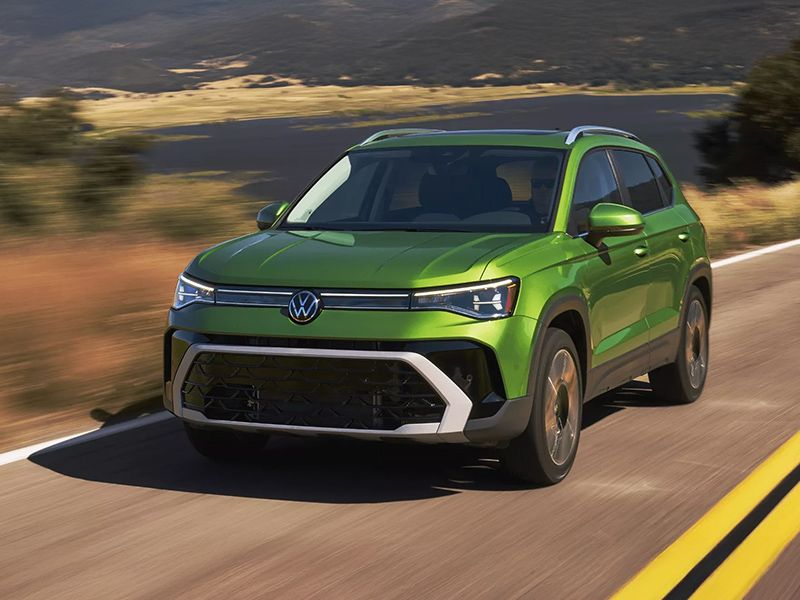
For buyers shopping the Volkswagen SUV lineup, the 2026 Taos and 2026 Tiguan offer two compelling paths. While both deliver German engineering and refined drivability, they differ in size, power, and fuel efficiency — factors that could make or break your decision depending on your lifestyle.
The Tiguan has the upper hand when it comes to raw power. Its 2.0L turbocharged engine delivers 201 horsepower and 221 lb-ft of torque, compared to the 174 hp and 184 lb-ft generated by the Taos' smaller 1.5L engine. The Tiguan’s torque kicks in earlier at 1500 rpm, making it feel more responsive off the line and in passing maneuvers.
However, the Taos counters with superior fuel efficiency. Its combined consumption hovers between 7.4 and 8.4 L/100 km, while the Tiguan averages 9.3 L/100 km. For drivers prioritizing long-term savings or urban commuting, the Taos offers better economy.
Passenger comfort in both models is solid, but subtle differences could matter. The Tiguan provides more rear legroom — 1,021 mm vs. the Taos' 963 mm — giving rear passengers noticeably more stretch-out space. Shoulder room also slightly favours the Tiguan in both rows, although headroom in the Taos is marginally better up front.
Despite the Tiguan’s larger size, the cargo space is surprisingly similar. With the second row folded, the Taos tops out at 1,866 L versus 1,668 L for the Tiguan. With the seats up, though, the Tiguan regains the edge with 750 L compared to the Taos’ maximum of 790 L — but only in certain trims.
The Taos is a smart choice for urban drivers or small families looking for a refined, efficient SUV with excellent cargo space for its size. The Tiguan, on the other hand, is ideal for buyers who need stronger performance and a bit more rear-seat space. Choosing between them depends on what matters more: power and space or economy and agility.
Why Volkswagen Ownership Is More Affordable Than You Think
Affordability in today’s automotive market is no longer defined solely by the sticker price. Long-term ownership costs, warranty protection, and...
Read more
Your Guide to Volkswagen’s EV Prepaid Maintenance
Life is full of surprises — but the cost of caring for your electric vehicle doesn’t have to be one of them. With a new Volkswagen ID.4 or ID.Buzz...
Read more
Two Major AJAC Awards for Volkswagen
The Automotive Journalists Association of Canada recently handed out two major awards to German automaker Volkswagen at the Montreal International...
Read morePowered and developed by
